-

-
Magazine
What Counts in Processing

What developments are currently shaping the demand for barrier papers. How are you responding to these requirements?
Markus Rothböck: We combine lightweight, resource-saving base papers with barriers that meet high standards for protection against water vapour, grease and oxygen. The combination of base paper and coating provides reliable protection with a minimal use of materials. Our barrier papers are made from renewable raw materials and are recyclable, making them suitable for sustainable packaging solutions without compromising on protection or processing.
What functional properties are required of barrier papers for food packaging?
Markus Rothböck: Fundamental requirements include reliable protection against grease, moisture and oxygen, as well as sufficient mechanical stability. These properties must be maintained regardless of the temperature range.
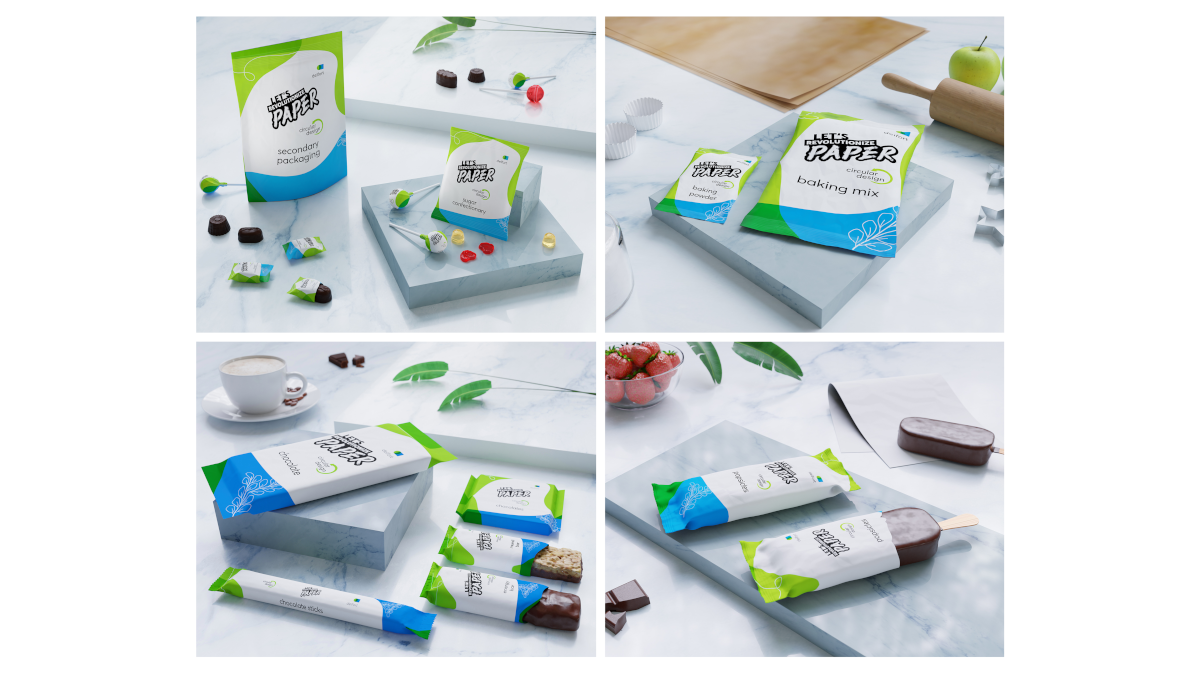
Barrier papers perform a wide range of tasks in practice: They serve as a grease barrier for products such as chocolate, butter or snacks. They prevent refrigerated goods such as cheese from drying out and protect powdered products from absorbing moisture and clumping. The oxygen barrier is equally important in preventing aroma loss (oxidation process).
Added to this is the resilience during transport and handling. The materials must remain stable under various climatic conditions. Our thinbarrier 303 barrier paper meets these requirements over a temperature range of –18 to +38 °C thanks to a combined oxygen, water vapour and grease barrier. It is essential to coordinate the base paper and barrier in order to achieve the required property profile.
What challenges arise when processing barrier papers – for example, during sealing, printing or machine runnability?
Markus Rothböck: As a rule, our papers can be used on existing machines, often without major adjustments. Suitable hot and cold sealability is important for creating tight, robust sealing seams. The materials are suitable for various types of packaging, such as tubular and stand-up pouches or wrapping applications.
The surface structure plays an important role in printing. Uniform and smooth surfaces enable good results in flexographic, gravure, digital and offset printing, for example in the form of sharp details or high colour stability.
How can barrier papers be successfully integrated into existing packaging lines – and what needs to be considered when switching from film to paper?
Markus Rothböck: Fibre-based materials must be sufficiently tensile and tear-resistant to be processed on equipment that was originally designed for films. To ensure a reliable transition, we first test each type of paper on our own machines for tensile strength, sealing parameters and speed.
The next step is a processing test at the customer's premises, during which fine adjustments are made. The strength of the paper and the correct settings for the sealing processes are crucial for a successful conversion. Our papers are designed to replace film material in existing lines.
© delfort
How does delfort develop new barrier papers – and how important are customer-specific requirements?
Markus Rothböck: The development is based on a structured process that begins with the customer's requirement profiles. These include required barrier properties, product protection, design specifications and sustainability goals.
Initial samples are created in our rapid prototyping centre and tested together with the customer. Criteria such as machine runnability, printability and recyclability are directly incorporated into future developments. We have test methods for preliminary evaluation, including shelf life tests (storage test). In cooperation with research institutions, further test results are being scientifically evaluated. These include the drying behaviour, mechanical resilience and whether uneven food surfaces, such as brittle or almond slivers, could damage the paper.
Another relevant point is migration: It must be ensured that no substances migrate into the packaging.
What key insights have you gained from your experience with barrier papers – and what trends are influencing development?
Markus Rothböck:
- Product protection remains a key priority. The challenge lies in combining barrier performance, sustainability and recyclability. We are working on barrier papers with an improved water vapour barrier, grease resistance and heat sealability, while maintaining high recyclability.
- Regulatory requirements are becoming increasingly important. From 2026, stricter PPWR requirements for recyclability and material reduction will apply. Our paper is highly recyclable in accordance with CEPI procedures. All our papers are PFAS-free, and we only use FSC® and/or PEFC-certified pulp.
- Collaboration along the supply chain is crucial. Cooperation with machine manufacturers, converters, printers and coating suppliers ensures reliable implementation in practice. Material efficiency, reliable processing and regulatory compliance determine the development of marketable barrier papers.
Information about the company:
delfort is an international manufacturer of speciality and functional papers based in Traun, Austria. The company develops and produces very thin, functional papers for applications in tobacco, pharmaceuticals, food, labels, and print & publishing. delfort employs over 3,200 people and operates several production and converting sites worldwide.
For additional information:
Markus Rothböck
Head of Packaging Division
delfortgroup AG
Fabrikstraße 3
4050 Traun Austria
food@delfortgroup.com
https://delfortgroup.com